
Krpano Is Obsolete. Here's What Modern Virtual Tour Software Should Look Like.
Krpano shaped virtual tours, but the web has moved on. Here's what modern virtual tour software should offer in 2026: no-code, WebXR, 3D, gaussian splats and more.
- virtual tours
- Krpano
- WebXR
- no-code
- Cyango
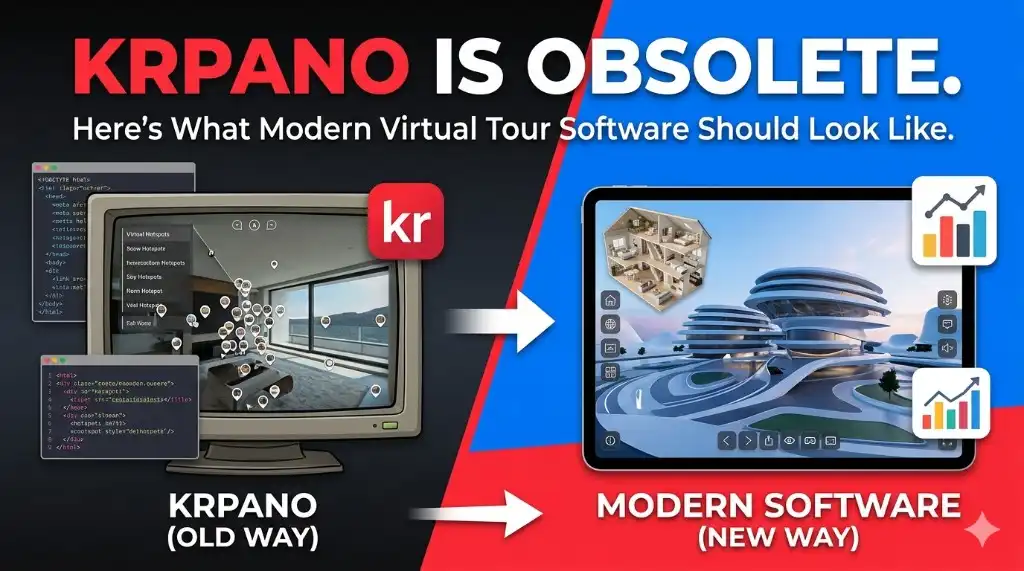
Krpano earned its chapters. It really did.
When an "interactive virtual tour" meant stitched panoramas, hotspots, XML, and a few brave people willing to debug plugins at midnight, Krpano was one of the tools that made the category real. A lot of good work shipped on it. A lot of clients got their first taste of spatial media through it.
But respect is not a product strategy.
The market moved. Buyers compare tours to smooth consumer apps. Creators compare workflows to Figma, Webflow, Canva, Notion, Unreal, and whatever else made collaboration feel normal. Clients expect links that work everywhere, fast updates, analytics, mobile sanity, brand control, and enough interactivity to support actual business goals.
If your software still makes every polish pass feel like firmware archaeology, that is not "power user flexibility." That is a tax.
What broke in the old virtual tour workflow
Old tour stacks were built around panoramas first. Stitch, place hotspots, link scenes, publish. That workflow made sense when the goal was "let people spin around." It starts to creak when the goal becomes storytelling, selling, training, onboarding, product education, or mixed-media WebXR.
The more clients ask for, the more old systems reveal their shape.
Need custom UI? You are in templates and scripts. Need brand-specific logic? Call the technical person. Need revisions from three stakeholders? Send builds around like it is 2006. Need headset, mobile, and desktop output? Start testing every assumption twice. Need analytics that actually help? Good luck explaining to a client why "page views" is not the same as understanding behavior.
Creators do not need more nostalgia. They need throughput.
Modern virtual tour software has different jobs
Virtual tours are no longer only room-to-room navigation. They are sales assets, training tools, destination previews, digital twins, product showrooms, investor materials, and branded experiences.
That means modern software needs broader foundations.
Reach actual devices. One publish path should work across browsers, tablets, phones, headsets, and large screens without inventing a new project every time. WebXR is not a buzzword here; it is distribution sanity.
Author without shame. Drag meaningful layouts, interactions, branding, media, and actions. Reserve scripting for differentiation, not boilerplate. If a creator needs code to change basic presentation, the tool is asking too much.
Mix media properly. 360 photos are useful, but modern experiences also need 3D models, Gaussian splats, video, audio, images, web embeds, forms, CTAs, and UI overlays. The tour should not collapse because the story needs more than panoramas.
Collaborate in the cloud. Teams should review, iterate, and publish without emailing files, guessing versions, or passing around mysterious folders named final_final_v7.
Instrument reality. Heatmaps, clicks, completion, scene drop-off, CTA behavior, and device context matter. Clients pay for outcomes. Creators need proof.
Why no-code matters, even for technical people
No-code gets mocked by people who think pain equals quality. I get it. Some no-code tools are toy boxes wearing enterprise shoes.
Good no-code protects expertise for work that deserves it.
If a senior producer spends hours rebuilding a button style, nobody wins. If a developer is needed every time marketing wants a new hotspot flow, the pipeline is broken. If the only person who understands the tour left the agency in 2021, congratulations, you built a museum exhibit about technical debt.
Modern software should make common work fast and custom work possible.
What should migrate and what should die
If you are sitting on an old Krpano library, do not panic and burn everything. Some assets still matter: high-quality panoramas, room logic, client-approved copy, hotspot strategy, media libraries, and brand lessons learned from real projects.
But many things deserve retirement: brittle scripts, one-off templates, undocumented plugin chains, mobile hacks, and interaction patterns that feel like they were designed for a mouse pretending to be a human hand.
Migration is not copying old tours into new containers. That only preserves the problem. Migration is a chance to ask: what was this experience supposed to achieve, and what would we build today if we were not trapped by old tooling?
Where Cyango comes from
We shipped plenty of Krpano-era tours before admitting the ceiling. No pitch-deck theory here. We felt the drag: too much code, too little iteration, not enough modern XR support, and workflows that made simple client requests weirdly expensive.
That friction pushed us toward Cyango: spatial publishing that treats virtual tours as part of a broader WebXR product stack, not a side quest bolted onto web circa 2009.
Create with visual tools. Bring in 360 media, 3D, splats, UI, actions, branding, and analytics. Publish to devices people actually use. Keep custom code available when the project earns it, but stop requiring it for basic dignity.
The uncomfortable truth
If you are still duct-taping old tour software while pitching "future-ready," clients will eventually notice. Maybe not in technical language. They will say it feels dated, slow, clunky, generic, hard to update, or "not quite what we imagined."
That sentence costs money.
Krpano had its time. Modern virtual tour software needs to respect what the category became: less panorama viewer, more experience platform. To compare the top WebXR platforms or see how Cyango vs 3DVista stack up, start with those guides.
Want migration straight talk on what carries over versus what deserves retirement before you renew another year of survival mode? Create a free Cyango account and rebuild the proof in xr/studio with your own scenes.