
How Digital Art Should Be Exhibited (Flat Screens Don't Cut It Anymore)
Flat screens don't do digital art justice. Discover how immersive, 3D and WebXR exhibitions let artists show work in space — and engage audiences on any device.
- digital art
- NFT
- galleries
- WebXR
- immersive
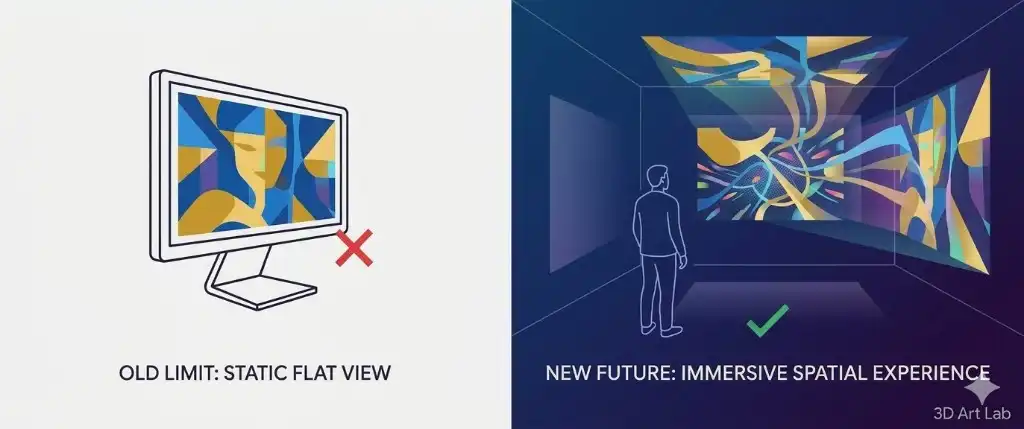
If your digital work still lives as a JPEG drop on a white page, we should talk.
That worked when digital art was still explaining itself to the room. A clean portfolio, a few thumbnails, maybe a marketplace link, maybe a sentence about the process. Fine. People understood the compromise because everything was new and everyone was improvising.
Now buyers compare against generative drops, NFT marketplaces, immersive installations, live streams, Discord communities, and physical galleries that learned how to perform scarcity better than most startups. A flat embed does not fail because it is ugly. It fails because it refuses context. Gaussian splats, WebXR rooms, and storytelling-first exhibitions fix that — especially when work must read on any device, including VR/AR headsets.
Digital art is not less real because it is screen-born. But a lazy exhibition can make it feel disposable.
Flat screens flatten intent
Screenshots are brutal. They reduce motion, scale, texture, interaction, and process into one rectangular hostage situation. If the work was made to evolve, react, loop, glitch, shimmer, or occupy space, a static preview amputates part of the piece before anyone decides whether to care.
This matters because buyers are not only evaluating pixels. They are evaluating meaning. Why this work? Why this edition? Why this artist? Why now? Why should this live in their collection instead of another tab they close at 1:00 AM?
Flat presentation gives them too little to hold.
Collectors buy story and confidence
Nobody likes admitting this because it sounds unromantic, but buying art involves risk. Emotional risk, financial risk, taste risk, status risk. Digital work adds more: wallet anxiety, authenticity, display questions, edition mechanics, platform longevity, and whether the buyer can explain what they bought without sounding like they joined a cult.
Good exhibition lowers those risks without killing mystery.
Show the work in context. Show process where process matters. Explain medium, edition, provenance, display options, and the artist's intent without writing a museum label that reads like it was assembled by committee after three espressos.
Help people enter the work without over-explaining it.
Virtual galleries should be designed around the work
A digital gallery does not need to imitate white walls unless white walls serve the piece. Some work wants silence. Some wants darkness. Some wants impossible architecture. Some wants a surreal room that would bankrupt a physical installation team in twelve minutes.
That is the advantage. Digital exhibition can be shaped around the art instead of forcing every piece into the same sterile corridor.
Lighting matters. Pacing matters. Sound matters if it supports the work and does not become ambient wallpaper. Hotspots matter when they reveal process, references, or collector information at the right moment. Spatial composition matters because people remember journeys better than grids.
Immersion is not decoration. It is framing.
AR solves boring but real buyer anxiety
People still ask practical questions. Will it fit this wall? How does it look above my desk? Does it feel loud in a living room? What scale works?
AR wall preview is not gimmicky when it helps someone decide. It turns "I like it" into "I can see it here." That is a dangerous sentence in commerce, in the best way.
For digital art tied to physical displays, prints, LED walls, frames, or mixed installations, AR becomes part of the sales journey. It lets collectors rehearse ownership before spending money.
NFTs need better rooms, not louder marketplaces
NFT sales taught the art world one useful lesson and ten exhausting ones. Ownership rails matter, but marketplaces alone rarely create emotional context. They create listings.
Listings are not exhibitions.
If a token represents art, experience, access, or provenance, the surrounding environment should help buyers understand that relationship. What does ownership unlock? Where does the work live? What story does the edition carry? What happens after purchase?
When those answers are buried in platform UI, the work competes with noise. A custom immersive gallery gives the artist or brand control over sequence, explanation, and emotional temperature.
How Cyango fits
With Cyango, galleries become experiences you can iterate. Use templates when speed matters. Build custom worlds when the work deserves atmosphere. Add hotspots, media, AR previews, links to marketplaces, or direct sales flows. Publish across desktop, mobile, large screens, and WebXR without turning every exhibition into bespoke engineering.
Nobody needs every artwork turned into "metaverse." Please no.
It is about giving digital art a presentation layer that respects how it was made and how people decide to buy.
Sell the feeling first; invoices follow when people trust they understood what they bought.
Digital art deserves more than placeholders. It deserves rooms, rituals, and context that make buyers stay long enough to care.
If you want a blunt read on flat versus spatial presentation, create a free Cyango account and sketch the gallery flow in xr/studio.