
From Photos to 3D Models: Why E-Commerce Is Shifting to Interaction
E-commerce is moving from flat photos to interactive 3D and AR. See why shoppers expect to explore products in 3D, and how to add interaction to your store.
- e-commerce
- 3D
- AR
- commerce
- Gaussian splats
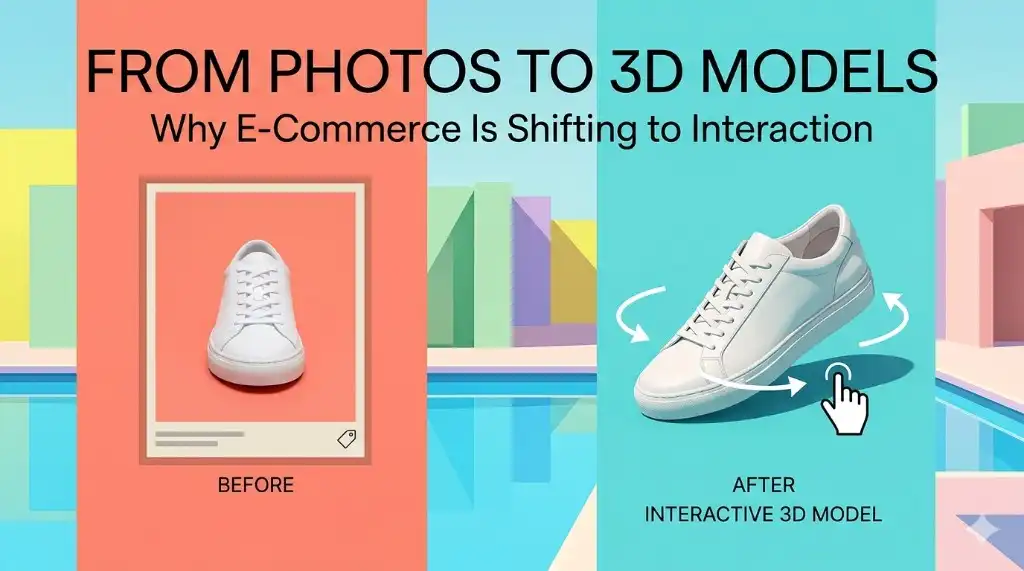
Flat photography carried online retail because logistics demanded it. Shoot SKU, clip background, export JPEGs, upload, repeat until everyone forgets there was ever another way.
It worked. Then customers got better at doubting it.
They zoom until pixels rebel. They scroll reviews looking for the photo that tells the truth. They ask whether the chair is smaller than it looks, whether the fabric shines weirdly, whether the bag holds shape, whether the lamp feels cheap. A product page can have twelve photos and still leave the buyer guessing.
That guessing is where carts die.
Photos explain look. Interaction explains confidence.
A good photo can sell style. It can show color, proportion, mood, and brand. I am not here to pretend photography is dead because some 3D founder discovered lighting.
But photos have a ceiling. They are chosen angles. They hide what they cannot answer. They cannot let someone inspect a hinge, rotate a sneaker, place a sofa in their room, or understand scale without translating dimensions in their head like a sad math exercise.
Interactive 3D changes the posture of the buyer. Instead of receiving proof, they investigate. They rotate. They zoom. They place. They compare. That small shift gives them agency, and agency builds trust.
For expensive or size-sensitive products, trust is not a nice brand word. It is conversion infrastructure.
Returns are often a visualization problem
Some returns happen because products are bad. Fine. Fix the product.
But many returns happen because expectations were wrong. The color was not what they imagined. Scale felt off. Material looked different in real light. Assembly or fit surprised them. The shopper did not buy the product you shipped; they bought the product they pictured.
3D and AR help close that gap before checkout.
A furniture buyer placing a chair in their living room is not playing with a gimmick. They are resolving anxiety. A shopper rotating a bag and inspecting seams is not wasting time. They are checking whether the object matches their self-image. Someone configuring finishes in 3D is not only customizing; they are rehearsing ownership.
If that sounds emotional, good. Commerce is emotional with a payment gateway attached.
Why this is finally practical
Making product models used to be ugly. Expensive rigs, specialist vendors, weeks of cleanup, angry spreadsheets, assets too heavy for mobile, and a team pretending "phase two" would fix everything.
Now capture is closer to the teams already handling product content. Phone scanning, photogrammetry, Gaussian splats for certain products or scenes, and better compression pipelines have changed the math. Not for every SKU, not perfectly, but enough to stop treating 3D like a museum project. Pair captures with 3D product showrooms in Cyango Stores and storytelling that converts.
The bottleneck moved. It is no longer only "can we make a model?" It is:
- Which products deserve 3D first?
- Who owns updates when packaging changes?
- Can merchandising publish without engineering every time?
- Does AR connect to checkout or live as a cute dead end?
- Can analytics tell us if interaction changed buyer behavior?
Those questions matter more than one beautiful demo.
Start with products where doubt is expensive
Do not scan the entire catalog because someone got excited in a meeting. Start where interaction answers real risk.
Furniture, home decor, appliances, fashion accessories, footwear, luxury goods, configurable products, and products with texture or scale ambiguity usually make stronger first candidates. Cheap commodity SKUs with obvious shape may not deserve the effort yet.
Build a pilot around measurable friction: return rate, conversion drop, support questions, showroom dependency, or high abandoned cart value. If 3D does not move something you care about, it becomes decoration.
How Cyango fits
Cyango focuses on turning assets into experiences people can actually use: bring scans or exports, wrap them in branded product showcases, add interaction, connect commerce hooks, and publish in formats that behave on phones, desktops, and headsets.
The important word is "showcase." A model sitting alone on a product page is only part of the job. The surrounding flow matters: copy, hotspots, variants, room placement, related products, CTA timing, and how quickly your team can update all of it without waiting for a developer sprint.
Speed wins because merchandising does not move annually. It moves weekly. Sometimes daily if the team is slightly cursed.
Photos are not going away
Static catalogs will not vanish. They should not. Photography still sets tone and gives fast overview. Video still sells motion and use. 3D adds inspection and confidence.
The winning stack is not photo versus 3D. It is photo plus video plus 3D plus AR, used only where each medium earns its place.
If your product pages still rely on JPEG hero culture for items that buyers need to understand spatially, you are probably eating avoidable returns and abandoned carts.
Curious whether your SKU mix earns 3D first? Create a free Cyango account, lay out a quick product scene in xr/studio, and judge from a browser preview instead of a six-month innovation theatre project.