
Insects Explorer: macro Gaussian splats as a science lesson
How Dany Bittel's macro insect Gaussian splats became one guided, shareable experience for classrooms, with hotspots and AR and VR, built with no code.
- Dany Bittel
- Education
- Storytelling and content creation
- Gaussian splat integration
- xr/studio
- Gaussian splats
- WebXR
- 3D capture
About Dany Bittel
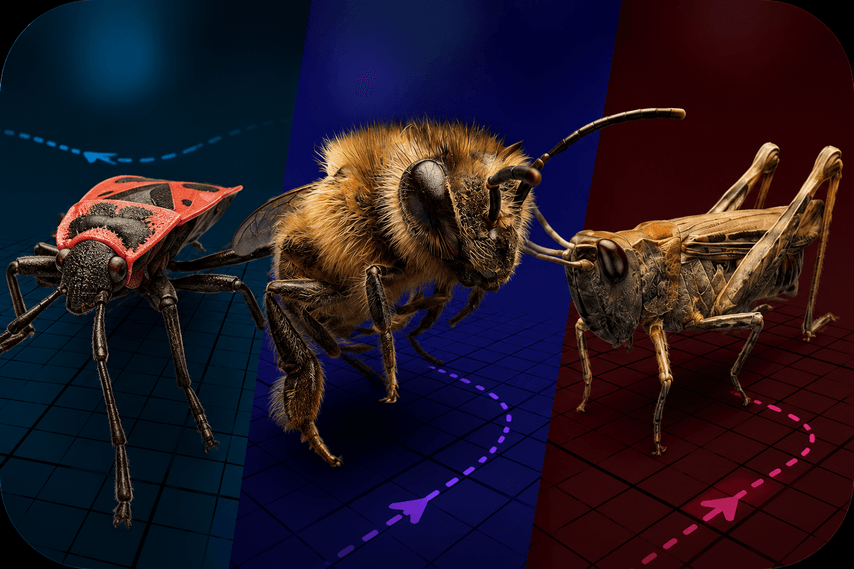
Dany Bittel is a digital artist and developer from Switzerland, with a background in visual effects, animation, rendering and interactive installations. He captures insects as Gaussian splats at macro scale.
Each subject takes hours of work: focus stacking, masking, a COLMAP reconstruction and a training pass in Postshot. The capture is already an artwork.
Objectives
A splat file on its own stays a file. A viewer shows the model, but it does not explain the subject, it does not guide the eye, and it does not connect one insect to the next.
The goal was to turn a set of macro insect splats into one experience for classrooms and for curious visitors. The experience had to:
- Show each insect at the quality of the original capture.
- Give the viewer a reason to look closer, and tell them what they are looking at.
- Stay one link, and not a folder of separate files.
- Open on a phone, a laptop or a headset, with no install.
Solution
We used the splats as the subject of a guided exhibition, and not as models in a viewer.
Each insect gets its own scene, with a camera position that frames the subject the way the capture deserves. Around the splat, the experience adds the layer that a raw file cannot carry: names, explanations and a path through the subject.
Execution
The experience was built in xr/studio, with no code:
- One scene per insect, with the splat loaded and framed.
- Hotspots on the parts that matter: the wing membrane, the compound eye, the hairs along the body.
- Short text panels that name each part and explain it.
- A guided path, so a first-time viewer sees the subject in an order that makes sense.
- Navigation between the insects inside the same experience, so there are no new links to find.
The experience is published to one link. The teacher opens the link. The students open the same link on their own phones. A headset user enters VR from the same page.
The same splats also run in AR on phones. Here is the experience side by side on iOS and Android:
Results
The captures are now a lesson that anyone can open. The detail of the original splats survives in the browser, the subject comes with context, and the whole set is shared as one address instead of several files.
Captures and artwork by Dany Bittel. See more of his macro work at danybittel.ch/macro, and his capture workflow in Lidar News.