
Digital Local Commerces: interactive applications for municipalities, without app stores
How Digital Local Commerces delivers spatial content for municipalities as browser experiences: 360 tours, maps, points of interest and reusable prefabs, published to a link.
- Digital Local Commerces
- Municipalities
- Virtual tour production
- Prefab library
- xr/studio
- public sector
- virtual tours
- prefabs
- PWA
About Digital Local Commerces
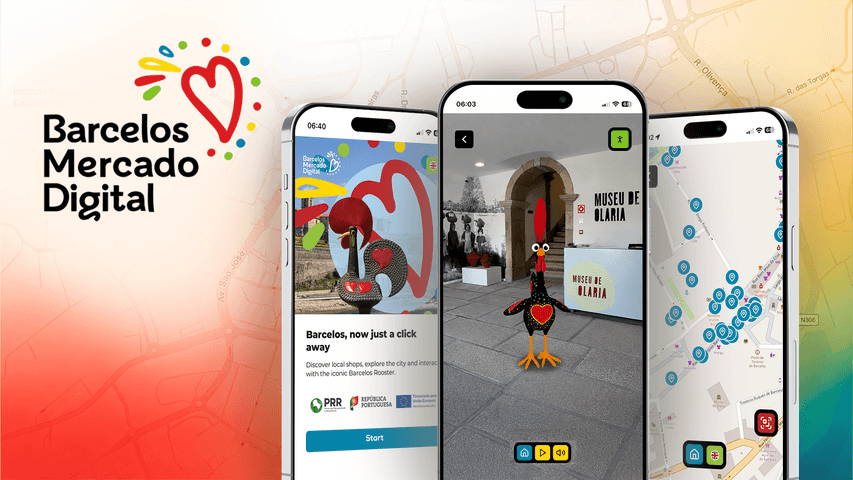
Digital Local Commerces builds interactive applications for municipalities. Their clients hold content that is spatial by nature: a historic centre, a museum, a renovation plan, a network of trails, a new public building.
Objectives
The usual formats do not carry that content well. A PDF flattens it. A photo gallery loses the sense of place. A native application costs money to build, and more money to keep alive in two app stores.
Digital Local Commerces needed a way to:
- Deliver spatial content for several municipalities, at a cost that a municipal budget accepts.
- Give each municipality its own experience, and keep the projects separate.
- Publish in a format that a citizen opens with no install.
- Update the content after delivery, without an app store review.
Solution
Each municipality gets its own project, built from the same set of parts. The parts that repeat between clients are authored one time as prefabs, then reused. The work for each new municipality is content, and not a rebuild of the interface.
Execution
Every project is assembled from these elements:
- 360 tours of the sites that matter to that municipality.
- A map or a floor plan scene, used as the index of the experience.
- Points of interest with text, photos, audio and video.
- Language options, so the same experience serves residents and visitors.
- Prefabs for the shared parts: a point of interest, an information panel, a navigation bar.
Each municipality has its own workspace, with its own assets and its own team access. The experience is published to a link, with offline support through PWA for sites with poor mobile coverage.
Results
A citizen does not install an application to read one page of municipal information. The link removes that step, and opens in the browser on the phone the citizen already holds.
The same link works on the tourist office screen, on a QR code on a street sign, and in a post on the municipality social channels. Updates go out by publishing again, so no version stays behind on an old phone.